Fort Myers, FL · Leak Detection Guide

Who Should I Call for a Ceiling Water Leak: A Plumber or Roofer in Fort Myers, FL?

A brown stain is spreading across your ceiling, and the first question is not how to fix it — it is who to call. Get it wrong and you pay for the wrong trade's visit while the real leak keeps running. Get it right and the source is found the same day. The good news is that a ceiling water leak in Fort Myers, FL almost always announces its source if you know what to watch: roof leaks follow the weather, plumbing leaks follow water use, and a third cause — your air conditioner's condensate drain — follows neither. Run the three tests below and you will know which phone call to make in about ten minutes.

Published November 15, 2026 · Water Leak Repair Fort Myers FL

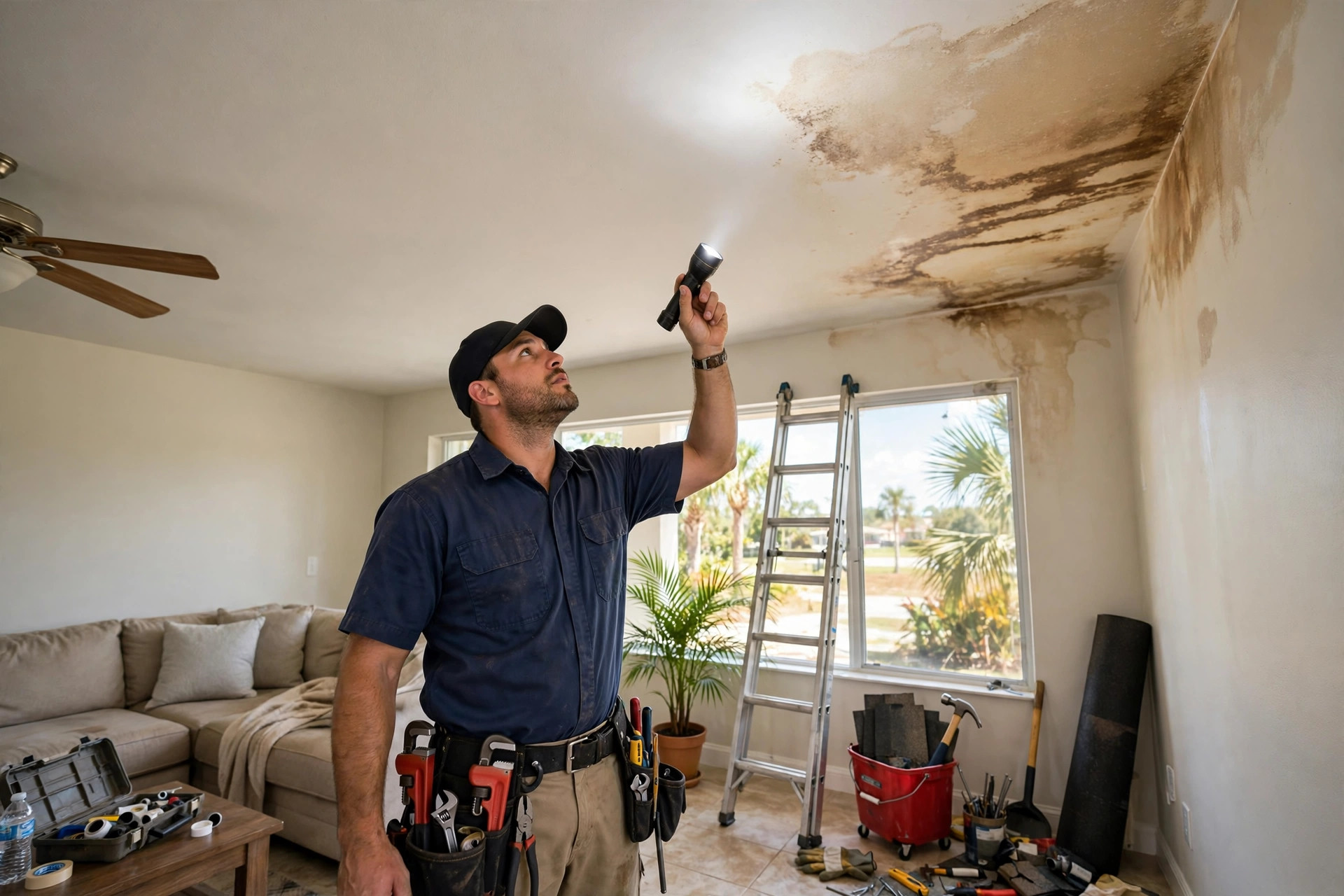
Homeowner and plumber inspecting a brown water stain on a living room ceiling in a Fort Myers FL home, with roofing tools visible nearby
DIRECT ANSWER

Who Should I Call for a Ceiling Water Leak: A Plumber or Roofer in Fort Myers, FL?

For a ceiling water leak in Fort Myers, FL, call a plumber if the leak appears on dry days, worsens when a shower, toilet, or washing machine runs upstairs, or keeps dripping after the rain has stopped — that points to a pipe, drain, or fixture above. Call a roofer if the stain appears or grows only during or after rain, sits on a top-floor ceiling near an exterior wall, or follows one of Fort Myers' summer downpours — that points to shingles, flashing, or a roof penetration. If you are unsure, call a plumber first: a leak detection visit can prove the source with a meter test in minutes, and a plumber can tell you honestly when the problem is the roof.

Quick Answer

Plumber or Roofer? The Quick Routing Table

What the leak doesMost likely sourceWho to call first
Appears or grows only during or after rainRoof — shingles, flashing, valley, or a penetrationRoofer
Appears on dry days, or grows steadily regardless of weatherPlumbing — supply line, drain, or fixture abovePlumber
Worsens when a shower, toilet, or washing machine runsPlumbing — fixture, drain, or supply linePlumber
Stops when you shut off the main water valvePressurized plumbing — supply linePlumber
Appears when the AC runs, near the air handlerAC condensate drain or drain panHVAC technician or leak detection
Water has stopped but the ceiling is still wet or saggingDamage already doneWater damage restoration, after the source is fixed
Ceiling is sagging, bulging, or water is near electricsEmergency, any sourceEmergency help now — stay clear of the area

Two or three clues pointing the same way are usually enough. One clue alone is not proof — water travels along joists, pipes, and framing before it finally stains the ceiling, so the wet spot can sit several feet from the actual break.

The 3-Test Rule

The Rain Test vs the Fixture Test vs the Meter Test

This is the fastest way to sort a ceiling water leak plumber or roofer question, and you can run all three without tools.

1. The rain test. Ask one question: did it rain in the 24 to 48 hours before the stain appeared or grew? In Fort Myers, that is easy to answer — summer afternoon thunderstorms are a daily event from June through September, and hurricane-season rain is hard to miss. If the stain only misbehaves after storms and sits quiet for days in dry weather, the roof is your prime suspect. One caution: a roof leak can keep dripping for a while after the rain stops, because water collects in insulation and framing before working its way down. So timing is a strong clue, not proof on its own.

2. The fixture test. Run one fixture at a time — the shower directly above the stain, then the toilet, then the bathroom sink — and check the ceiling underneath within 20 to 30 minutes. Fresh dampness appearing shortly after running a fixture is a reliable sign of a pipe or drain issue rather than a roof problem. If nothing changes, the fixture is probably innocent.

3. The water meter test. Turn off every tap and appliance in the house, then watch your water meter. If the dial or the small leak indicator is still moving, water is escaping somewhere in your pressurized plumbing — and that is a plumbing issue, not a roofing one, full stop. A moving meter with all fixtures off is the closest thing to a certain answer you can get without equipment.

Pro tip

Keep a simple log for a day or two — when the stain grows, whether it rained, and which fixtures were used. Growth that lines up with rain suggests the roof; growth on dry days suggests plumbing. Two or three entries usually settle it.

Call a Plumber

Call a Plumber When the Leak Follows Water, Not Weather

Call a plumber first when any of these are true:

  • The stain grows on dry days, or keeps growing days after the last rain.
  • The leak starts or worsens while a shower, toilet, washing machine, or dishwasher above is running.
  • The ceiling is directly below a bathroom, kitchen, laundry room, or water heater.
  • You hear dripping or running water inside the wall or ceiling with every fixture turned off.
  • Your water bill jumped without any change in how you use water.
  • The stain feels warm to the touch, or there is a warm spot on the floor above — a hot-water line signature a roof leak never produces.
  • Shutting off the main water valve slows or stops the leak.

A plumber's job is the supply lines, drain lines, toilet seals, shower valves, and fixture connections above the ceiling — and, importantly, proving the source. If you are genuinely unsure whether the source is plumbing or roofing, start with a plumber anyway: most are experienced in distinguishing between the two, and a hidden water leak detection visit with acoustic listening and a meter test can confirm a plumbing source — or rule it out honestly and send you to a roofer instead of charging you for a repair you do not need. A pipe leak repair is a targeted fix once the break is located; the expensive mistake is opening the ceiling in the wrong place.

Warning

If the ceiling is sagging, bulging, or cracking under the weight of trapped water, stay clear of it — a saturated ceiling can collapse without warning. Put a bucket underneath, move valuables out of the way, and call for emergency water leak repair rather than waiting for a routine appointment.

Call a Roofer

Call a Roofer When the Leak Follows the Rain

Call a roofer first when the evidence points outside:

  • The stain appears or darkens during or after heavy rain, then dries out between storms.
  • The stain sits on a top-floor ceiling, near an exterior wall, or beneath a skylight, chimney, or roof vent.
  • You can see missing, cracked, or slipped shingles, damaged flashing, or a blocked valley from the ground.
  • The leak started after a storm — Fort Myers' summer downpours and hurricane-season winds are hard on flashing and roof penetrations.
  • The attic shows daylight through the roof deck, damp insulation near the roof surface, or water trails on the underside of the decking.

Roofers handle the exterior water barrier: shingles, flashing, valleys, gutters, and penetrations. The most common roof-leak entry points are not the middle of the roof — they are the joints: flashing around chimneys and vents, skylight seals, and valleys where two roof planes meet. That is also why a roof leak's stain often sits nowhere near the actual entry point; water runs along the decking and framing before it drops through. A focused roof repair commonly runs $350 to $1,500, while the source repair for a plumbing leak typically runs $200 to $1,550 — but either number is small next to the ceiling repair that follows if the leak runs for weeks. Water-damaged ceiling repair averages about $3,600, and water damage claims averaged $13,954 across 2018 through 2022, according to the Insurance Information Institute.

Never climb onto a wet roof yourself to look. Roofing work is dangerous in dry weather and worse in a storm — a roofer's inspection is the safe way to check, and a tarp over the roof is a job for them, not for a homeowner on a ladder in the rain.

The Third Cause

The Third Cause Fort Myers Homeowners Miss: the AC Drain

There is a third suspect that neither a plumber nor a roofer owns outright, and in Fort Myers it is common: the air conditioner's condensate drain. Your AC runs most of the year here, and the air handler — often sitting in the attic directly above the ceiling — produces a steady stream of condensation. If the drain line clogs, the drain pan overflows and the water drips straight onto the ceiling below.

Suspect the AC when the stain appears while the air conditioning is running hard on a humid day, sits near the air handler or under a ducted unit, and has no connection to rain or fixture use. Turn the AC off, and call an HVAC technician — or a water leak detection specialist who can check the drain line and the pan. This is also why the "plumber or roofer" question sometimes has a third answer, and why a detection visit that checks all three systems is worth more than a guess.

Wrong Call

What Happens If You Call the Wrong Trade?

Calling the wrong trade first costs time, and time is what turns a stain into a claim. The U.S. Environmental Protection Agency notes that wet or damp materials dried within 24 to 48 hours will, in most cases, not grow mold — after that window, the odds change fast. A roofer who finds no roof problem will still charge for the inspection, and a plumber who finds no plumbing problem does the same. Worse, while you are waiting for the second appointment, the leak keeps soaking insulation, framing, and drywall.

The fix is the three tests above, run before either call. They take ten minutes and they cost nothing. And if the tests disagree with each other — the stain grows after rain and after showers — say so on the phone. A good pro will tell you whether they are the right first call or whether a detection visit should come first.

Before You Call

What to Do Before Anyone Arrives

  • Stop the water if you can. If the leak tracks with fixture use, shut off the water to that fixture or the main valve. If it tracks with rain, there is nothing to shut off — catch the water instead.
  • Protect the room. Put a bucket under the drip, move furniture and electronics, and lay down towels. If the ceiling is bulging, poke a small hole at the lowest point of the bulge with a screwdriver (only if it is safe to stand clear) so the water drains in a controlled way instead of bringing the ceiling down.
  • Cut power to the area if water is near lights or outlets. Do not stand in water near electrical fixtures.
  • Take photos and video. Dated photos of the stain, the drip, and any damage are useful for an insurance claim and for the pro who has to find the source.
  • Do not paint over the stain. Paint hides the evidence your pro uses to trace the leak, and the stain will bleed straight back through.
Fort Myers

Why Fort Myers Makes This Decision Easier — and Harder

Fort Myers gives you one advantage: the weather test is unusually clear. Afternoon thunderstorms roll through almost daily in summer, so a roof leak's pattern — worse after storms, quiet in dry spells — shows itself fast. The harder part is the housing stock. Many Fort Myers homes are single-story, slab-on-grade houses, which means the ceiling is directly under the roof — so a top-floor stain is the only floor, and the roof is always a suspect. Older neighborhoods still have original tile and shingle roofs whose flashing has had decades of sun and storm exposure, and a roof that survived last hurricane season can still have a flashing joint that fails in the next big downpour.

Whether you live in Downtown Fort Myers, San Carlos Park, Iona, or South Fort Myers, the rule is the same — rain means roofer, fixtures mean plumber, AC means the drain, and a wall and ceiling leak repair specialist can confirm the source before anyone opens your ceiling. The stain is the symptom; the timing is the diagnosis.

FAQ

Ceiling Water Leak: Plumber or Roofer? Fort Myers Homeowners Ask

It depends on the source. Call a plumber if the leak appears on dry days, worsens when a fixture runs, or sits below a bathroom or kitchen. Call a roofer if it appears or grows only during or after rain, or sits on a top-floor ceiling near an exterior wall. If you are unsure, call a plumber first — a leak detection visit can prove the source with a meter test and redirect you to a roofer if the roof is the problem.

Use the timing test. Roof leaks follow rain — the stain appears or grows during or after storms and dries out between them. Plumbing leaks follow water use — the stain grows steadily in dry weather, after showers or flushing, or when the water meter moves with all fixtures off. The fixture test (run one fixture, check the ceiling in 20–30 minutes) and the meter test confirm it.

Yes, when the source is plumbing — a supply line, drain line, toilet seal, shower valve, or fixture above the ceiling. A plumber can also diagnose the leak and tell you honestly when it is a roof problem instead. The ceiling itself — the drywall and paint — is a separate repair, usually handled by a drywall contractor or restoration company after the source is fixed.

That is a roof leak until proven otherwise. The entry point is usually flashing, a valley, a skylight, or a roof penetration — not the middle of the roof. Call a roofer, stay off the roof yourself, and expect a focused repair rather than a whole new roof unless the roof is at the end of its life.

Fixing the source typically runs $200 to $1,550, whether it is a plumbing repair or a focused roof repair. Repairing the water-damaged ceiling itself averages about $3,600. The gap between a same-day fix and a week-old stain is usually the gap between a repair and an insurance claim — which is why the 24 to 48 hour drying window matters.

Often, yes for the resulting damage — but it depends on the cause and your policy. Sudden, accidental leaks are usually covered; long-term leaks you knew about, or maintenance issues like a worn-out roof, often are not. Document the damage with dated photos, stop the leak, and call your insurer early — and check whether your policy covers the pipe or roof repair itself, or only the water damage it caused.

Still Not Sure Which Trade You Need? Get the Source Found First

Our 24/7 dispatch connects Fort Myers homeowners with local leak detection pros who find the leak before anyone cuts, digs, or demolishes — day or night, anywhere in Lee County.