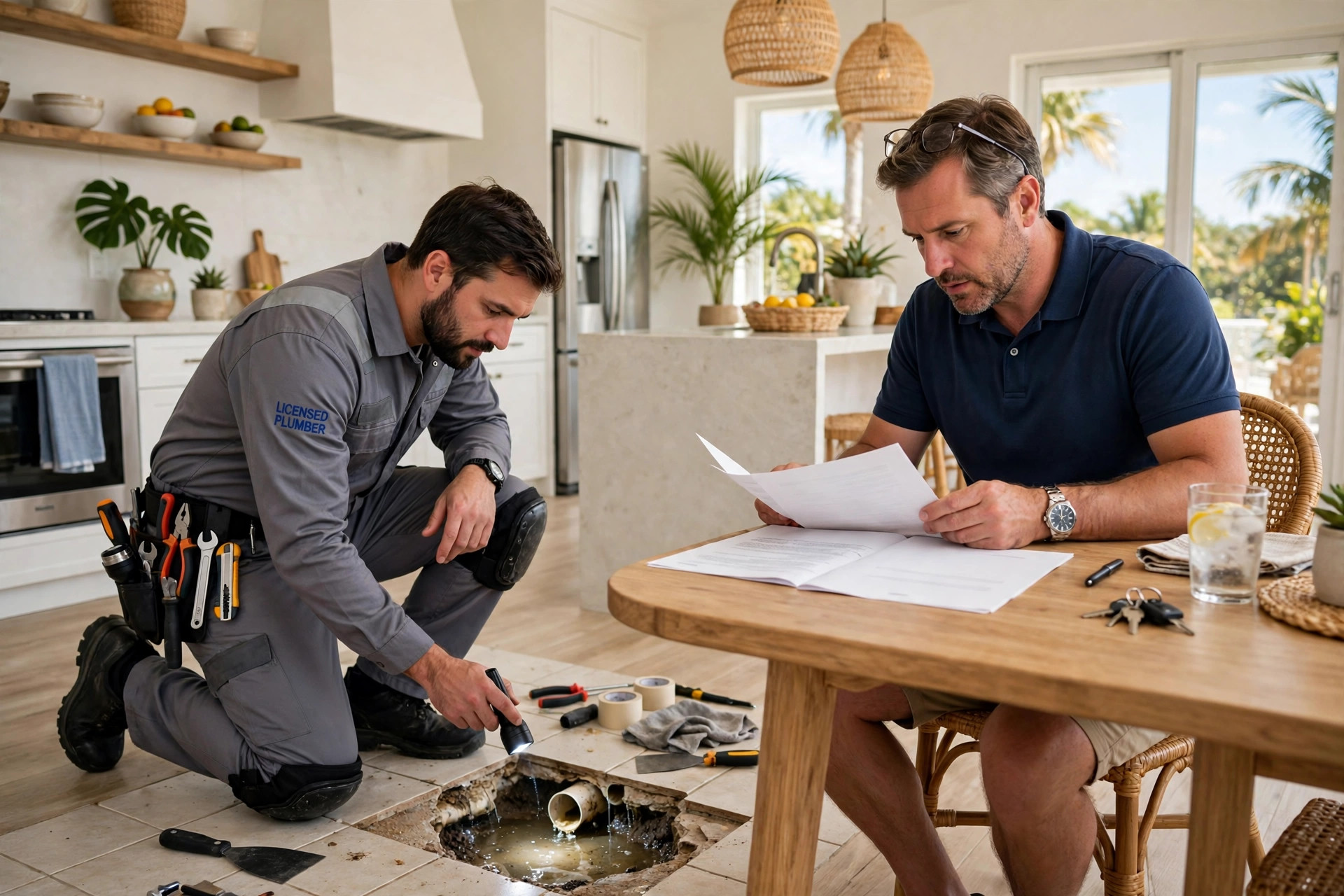
Most Florida homeowners carry an HO-3 policy, and almost all of them split a slab leak claim the same way: the failed pipe is your problem, the damage it caused is usually the insurer's. This split surprises people, so it is worth seeing plainly.
| Part of the job | Usually covered? |
|---|---|
| The failed pipe itself (repair or replacement of the corroded section) | Usually not — treated as wear and tear or maintenance |
| Water damage to flooring, drywall, cabinets, and belongings | Usually yes, if the leak was sudden and accidental |
| Tear-out / access — jackhammering the slab and replacing it to reach the pipe | Often yes under standard HO-3 policies |
| Leak detection (acoustic + thermal imaging) | Sometimes — check your policy; detection reports also help prove the claim |
| Mold remediation | Often capped — many Florida policies limit mold to around $10,000 |
| Foundation movement or settling caused by the leak | Often limited or excluded, even when the water damage is covered |
| A slow leak that seeped for weeks or months | Usually excluded under the gradual-damage / seepage exclusion |
The practical result: on a typical Fort Myers slab leak job that runs $630 to $4,400 all-in, the pipe fix itself might be only a few hundred dollars — while the access work and the flooring restoration, the parts insurance often does pay for, are the expensive half. That is why the claim is worth filing even when the pipe itself is excluded.
Never tell an adjuster the leak "has been going on for a while" or "the pipes are just old." Those phrases point straight at the wear-and-tear and gradual-damage exclusions — the two most common reasons Florida slab leak claims get denied. Describe what you noticed and when you noticed it, and let the detection report speak for the cause.