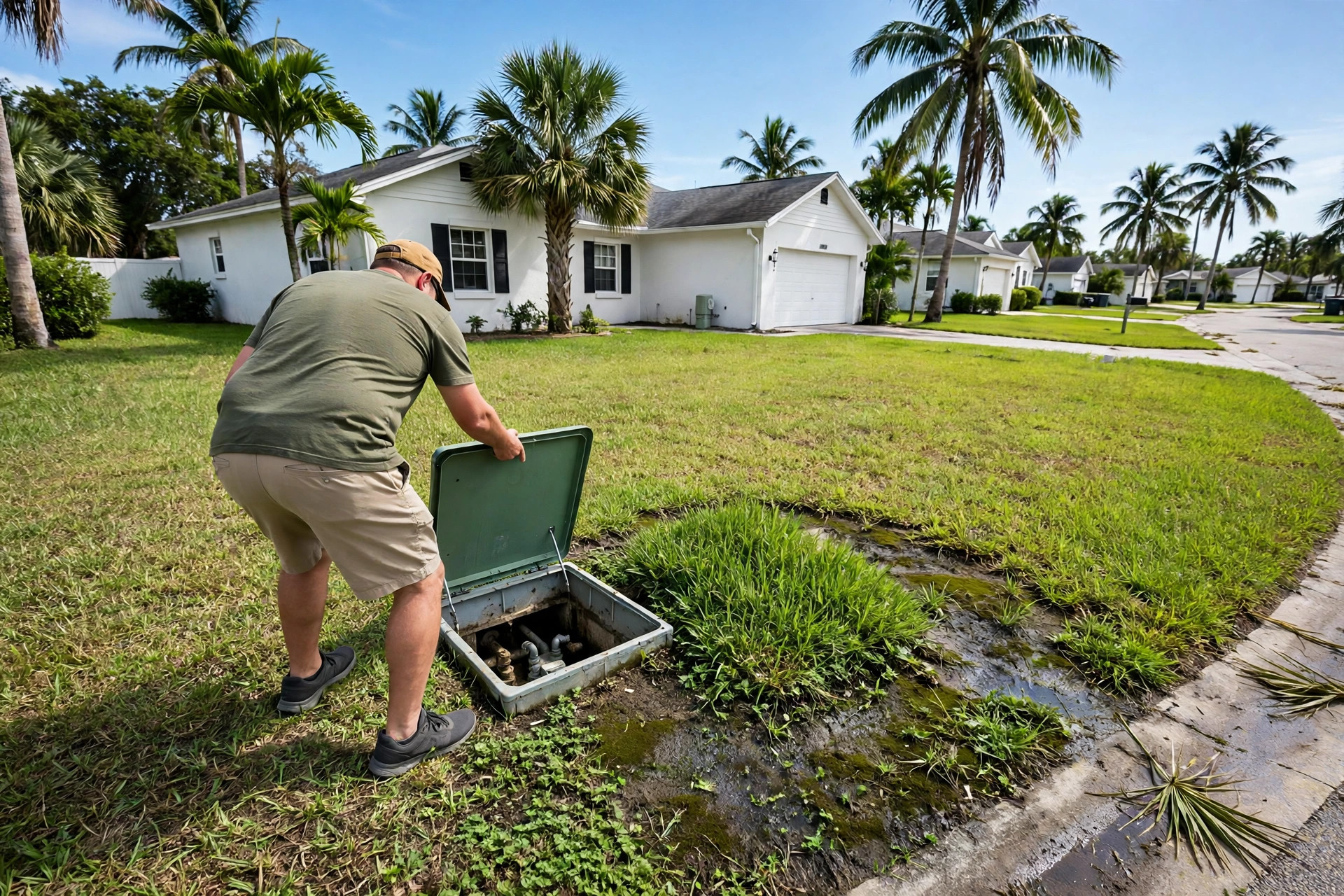
A main water line leak rarely announces itself with a burst. It starts as a pinhole or a cracked joint and quietly loses water into the soil, day after day. A pinhole-sized leak can waste around 250 gallons a day — enough to fill a bathtub twice over — while a severe break can lose thousands of gallons daily. Watch for these signs, and take it seriously when two or more show up together.
- Your water bill jumps with no change in use. This is the number-one indicator. If usage climbs 30, 50, or 100 percent and you have not filled a pool, added guests, or changed your irrigation schedule, water is going somewhere it should not. A bill that keeps climbing month after month, with no change in routine, is a buried leak until proven otherwise.
- The meter moves when nothing is running. Your water meter has a small leak-indicator dial — usually a little triangle or star — that spins with even a tiny flow. Turn off every tap, toilet, appliance, and irrigation zone, then look at the meter. If the indicator keeps turning, pressurized water is escaping somewhere in your system.
- Water pressure drops at every cold tap at once. A main line leak steals volume before the water ever reaches your house, so the whole house feels it. If every cold tap is weak but the hot water runs strong, the leak is upstream of your water heater — that is the main line, not a single fixture. One weak faucet is a faucet problem; every faucet weak at the same time is a supply problem.
- A soggy or unusually green strip in the lawn. Water escaping underground saturates the soil in one spot, and the grass above it stays greener, grows faster, and feels spongy underfoot — even days after the last rain. In Fort Myers, look along the path between the street meter and your house: that is where the service line runs.
- You hear running water when everything is off. Stand quietly near the meter box or the main shut-off valve with the house silent. A faint hiss, trickle, or rushing sound means pressurized water is moving where it should not be. Drain lines are quiet by comparison — they only carry water when a fixture runs.
- The water looks or tastes off. Brown, yellow, or cloudy water at every tap can mean soil and sediment are entering through a crack in the line. An earthy or metallic taste points the same way. If it is only one tap, suspect that fixture; if it is the whole house, suspect the main line.
- Cracks or sinking in the driveway or walkway. Water leaking under hardscaping washes the sandy base out from underneath it. Pavers shift, concrete cracks, or a section of driveway starts to sink along the line's path. By the time the surface moves, the leak has usually been running for a while.
Warning
In Fort Myers' sandy soil, an underground leak can run for weeks without ever surfacing as a puddle. Do not wait for standing water to take the signs seriously — the bill and the meter are the early warnings, and the longer a pressurized leak runs, the more soil it washes out from under your lawn, driveway, or slab.