Fort Myers, FL · Leak Detection Guide

How Much Does Main Water Line Leak Repair Cost in Fort Myers, FL?

You found the leak — or at least, the meter test proved it is in the buried main water line between the street and your house. The next question is the one every homeowner asks first: what is this going to cost me? The honest answer is that main water line leak repair cost in Fort Myers, FL depends on how much pipe is involved and how hard it is to reach, but the range is narrower than most people fear. A single break in an otherwise healthy line is usually a one-day, four-figure-or-less job. A full replacement of an old, failing line is the bigger bill — and knowing which one you need before anyone digs is what keeps the price from surprising you.

Published November 14, 2026 · Water Leak Repair Fort Myers FL

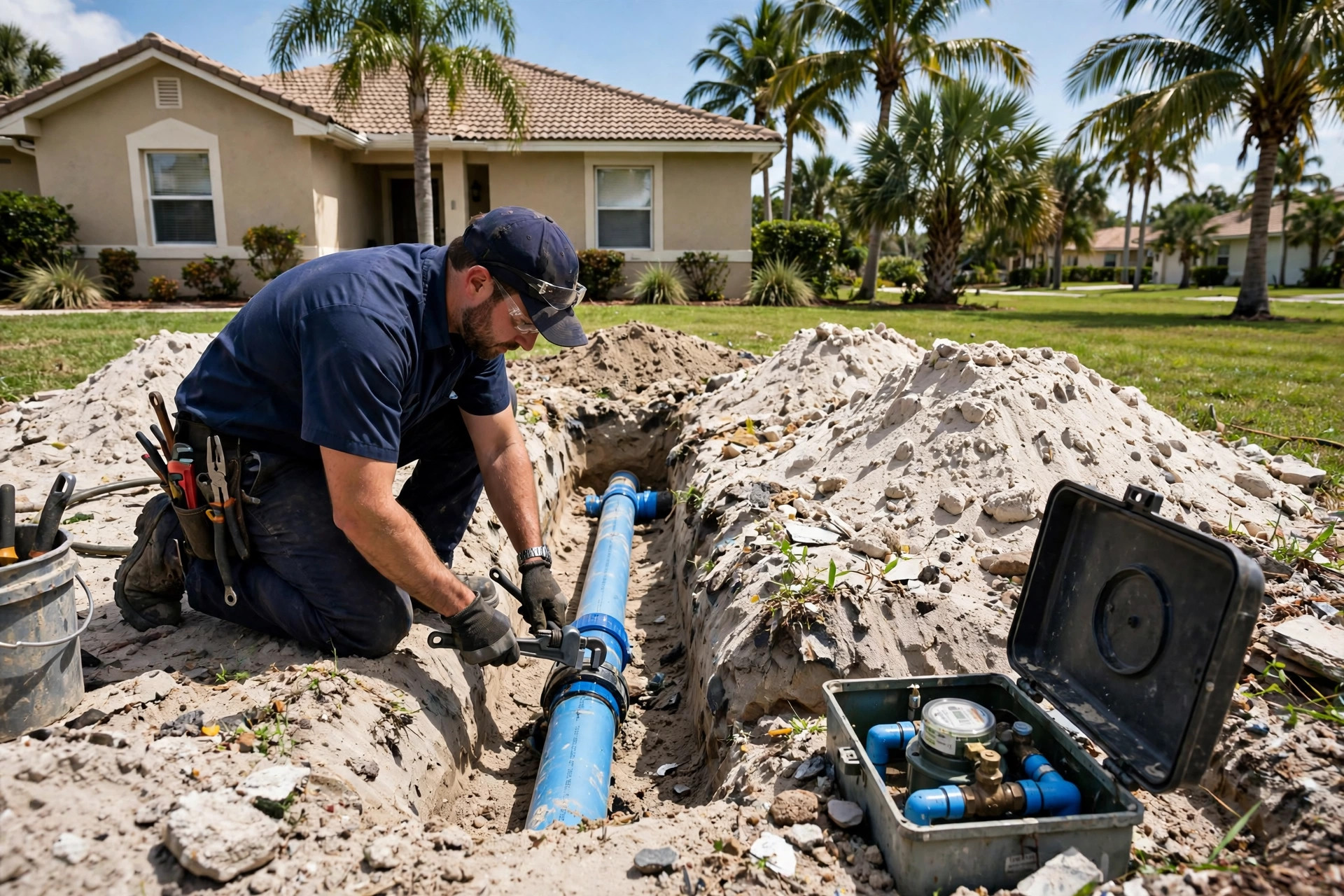
Plumber repairing a main water service line in a shallow trench in a Fort Myers FL front yard, with a water meter box open nearby
DIRECT ANSWER

How Much Does Main Water Line Leak Repair Cost in Fort Myers, FL?

In Fort Myers, FL, main water line leak repair cost typically runs $400–$1,500 for a spot repair on a single break, with most homeowners paying around $950–$1,025. A full replacement of the service line from the meter to the house usually costs $2,000–$5,000, and up to $12,500 for long or difficult runs. Florida's shallow burial depth (about 2.5 feet) and sandy soil keep digging costs lower than in northern states, where the same job often runs higher. The final price depends on the length of pipe involved, the repair method (open trench at $50–$200 per foot versus trenchless at $70–$250 per foot), the pipe material, and how much surface — lawn, driveway, or sidewalk — sits above the line. Because the line from the meter to your house is yours, not the city's, the repair bill is the homeowner's.

Cost at a Glance

Main Water Line Leak Repair Cost at a Glance

Here is the short version, based on 2026 pricing data from Angi, HomeServe, and independent cost guides. These are typical ranges for residential work, not quotes — your exact price depends on your yard, your pipe, and how long the damaged section is.

JobTypical cost in Fort Myers / Florida
Leak detection and diagnosis$150–$650
Spot repair (single break, one section)$400–$1,500
Full line replacement (trenched)$2,000–$5,000
Full line replacement (trenchless)$2,500–$12,500
Per linear foot, open trench$50–$200
Per linear foot, trenchless$70–$250

The national average for a main water line repair in 2026 is about $1,025, with most homeowners paying between $354 and $1,696, according to Angi's data from 1,622 verified projects. Florida runs a little below the national average: HomeServe's state figures put a Florida repair at $742 on average and a replacement at $2,731. Tampa-area data shows $50–$100 per linear foot and an average job cost of $427, while Orlando averages about $320 for a repair. Fort Myers sits in the same Florida band — and one local factor helps: the service line here is buried only about 2.5 feet deep, compared with a national average of nearly 4.6 feet, so there is simply less digging to pay for.

Pro tip

The detection visit is usually a separate line item — $150 to $650 for electronic leak detection. Many specialists credit some or all of that cost toward the repair if you have them do the job, so ask before you book.

Repair vs Replace

Repair or Replace? The Decision That Sets the Price

The biggest fork in the road is whether you fix one spot or replace the whole line, and the right answer depends on the pipe, not the price list.

Repair the spot when it is a first break in modern pipe. Copper, PEX, and PVC service lines last 50 to 100 years, and a single failure in one of them is usually bad luck — ground shifting, a rock pressing against the pipe, or a shovel nick from an old landscaping job. A spot repair means excavating to the break, cutting out the damaged section, splicing in new pipe, and backfilling. It is priced by the job, not by the foot, because only one spot gets opened.

Replace the line when the pipe has already broken before, or it is old galvanized steel or cast iron. Corrosion in those materials is line-wide, not local: if one section has rusted through, the next section is on the same schedule. A second break in the same line is a strong signal that another repair is just buying time. Replacement is priced per linear foot because the whole run from the meter to the house gets renewed — and it is also the moment to upgrade to modern PEX or HDPE, which resist the corrosion that killed the old line.

A good rule of thumb from the cost data: a 60-foot line with a first break in copper costs roughly $400–$1,500 to repair, but $3,000–$12,000 to replace. If the line is old and has failed twice, the replacement starts to win on total cost — you pay once instead of paying for the same excavation two or three times.

Cost Factors

7 Factors That Move Your Main Water Line Repair Cost

Two neighbors with the same leak can get very different quotes. Here is what actually drives the number.

  1. Length of pipe involved. A spot repair covers one break, so length barely matters. A replacement is priced per foot, so a 30-foot run from a meter close to the house costs far less than a 100-foot run across a deep lot. Every extra foot adds pipe, labor, and restoration.
  2. Depth of the line. Fort Myers lines sit shallow — about 2.5 feet — which is why Florida digging costs run lower than in states where frost lines push pipes four or five feet down. A line buried deeper than usual, or one running under a raised grade, costs more to expose.
  3. Repair method: trench vs trenchless. An open trench ($50–$200 per foot) is cheaper per foot but tears up everything above the line. Trenchless methods like pipe bursting or pulling a new line through ($70–$250 per foot, or $900–$2,300 for a typical Orlando-area job) cost more per foot but leave the yard, driveway, and landscaping intact. Under a driveway or a mature landscape, trenchless often wins on total cost once restoration is counted.
  4. Pipe material. The new pipe itself is the cheapest part of the job. Per foot, PEX runs about $0.50–$1.50, PVC $0.75–$3.00, HDPE $1.25–$4.00, and copper $2.50–$5.00. Copper costs more and takes longer to install, but it is durable and approved by local code everywhere. PEX is flexible and corrosion-proof, though not every jurisdiction allows it underground — your plumber will know the local code.
  5. What sits above the line. A leak under open lawn is a quick dig. The same leak under a concrete driveway, a paver walkway, a patio, or a sidewalk means cutting, removing, and restoring that surface — and restoration can add hundreds or thousands to the bill. This is the single biggest reason two similar leaks price differently.
  6. Sandy soil and the water table. Fort Myers' sandy soil is a mixed blessing. It digs easily, which keeps labor down, but it also washes out fast around a leak — and the high water table means a trench can fill with groundwater while the crew works. A leak that has been running for weeks may have already undermined the soil under a driveway or slab, adding repair work beyond the pipe itself.
  7. Permits and timing. A main line replacement usually needs a permit from the City of Fort Myers, and the permit fee and inspection add to the total. Emergency or after-hours work — a break that is flooding the yard at midnight — carries a premium over a scheduled daytime repair. If the leak is not an emergency, a weekday appointment is the cheaper call.
Warning

Before anyone digs, call 811. The service line shares the ground with gas, electric, and communications lines, and a shovel in the wrong place turns a water repair into a much bigger emergency. Locating utilities is free, and it is required.

Fort Myers

What Makes Fort Myers Different

Most national cost guides assume a northern yard: deep frost lines, clay soil, and a long dig. Fort Myers is different in three ways that show up in the bill.

First, the shallow depth. At roughly 2.5 feet, a Fort Myers service line is about half as deep as the national average, so excavation is faster and cheaper. Second, the sandy soil. It digs easily and drains fast — which is also why a leak here often shows no puddle at all: the water disappears into the ground before it can pool, and the first sign is usually a bill spike or a spinning meter rather than a wet yard. Third, the age mix of the housing stock. Older Fort Myers neighborhoods still have original copper or galvanized service lines from the 1970s and 80s, and those are the lines that fail in clusters — once one section goes, the next is usually not far behind, which is when replacement beats another spot repair.

One more Fort Myers-specific point: the line from the meter to your house is yours. The city maintains the main under the street, but the service line running from the curb stop or meter to your home belongs to the homeowner — including the valves at both ends — and most homeowners insurance policies exclude it. That is why a repair quote can feel surprising: there is no utility or insurer picking up the tab. On the plus side, you can track the leak's cost in real time through the City of Fort Myers' WaterSmart portal, which flags unusual usage before the next bill arrives — and dated meter readings are useful evidence if you ever ask the city about a bill adjustment.

Getting Quotes

How to Get an Accurate Quote (and Avoid Overpaying)

A phone quote for a buried leak is a guess. A fair price comes from a visit, and here is how to make that visit count.

  • Confirm the leak is in the main line first. Run the meter test: turn off all water, watch the meter, then close the house shut-off valve. If the meter keeps spinning with the house valve closed, the leak is in the buried line. This is the test a main water line leak repair specialist will run anyway — doing it first means you call the right trade.
  • Get the location pinned before the quote. An underground water leak detection visit with acoustic listening equipment finds the exact break. A quote based on a known location is far more accurate than one based on "somewhere in the front yard," and it usually means a smaller excavation.
  • Ask for the price two ways. For a single break, ask for a flat spot-repair price. For a replacement, ask for the per-foot price and the total length, so you can compare quotes fairly. Also ask whether detection is credited toward the repair, what restoration is included, and whether the permit fee is in the number.
  • Compare at least two or three quotes. Florida pricing varies widely by contractor — Tampa data alone shows jobs from $165 to $1,650 — so one quote is never enough. Be wary of any quote given without a site visit, and of any price that is dramatically lower than the others: it usually leaves out restoration, the permit, or the detection.
  • Do not wait for the next bill. Every gallon the leak loses has already passed through your meter, so it is billed to you. A water leak detection call now is cheaper than another month of a leak running under your yard — and a leak left running can wash out soil under a driveway or slab, turning a pipe repair into a hardscape repair as well.

If the meter is spinning fast, water is pooling, or a section of driveway is sinking, treat it as urgent: shut off the main valve at the house and call for emergency water leak repair rather than waiting for a routine appointment. Whether you live in Downtown Fort Myers, San Carlos Park, Iona, or South Fort Myers, the math is the same — a spot repair on a first break in modern pipe, a replacement when the line is old or has failed before, and a detection visit before either one so the quote is based on a known location, not a guess.

FAQ

Main Water Line Leak Repair Cost — Fort Myers Homeowners Ask

A spot repair on a single break typically costs $400–$1,500, with most homeowners paying around $950–$1,025. A full replacement of the service line runs $2,000–$5,000 for an open trench, and up to $12,500 for long or difficult trenchless runs. Florida averages sit slightly below national figures — a Florida repair averages about $742, and a replacement about $2,731 — because service lines here are buried only about 2.5 feet deep in easy-digging sandy soil.

An open-trench repair or replacement runs about $50–$200 per linear foot, while trenchless methods run $70–$250 per foot. The pipe itself is cheap — PEX $0.50–$1.50, PVC $0.75–$3.00, HDPE $1.25–$4.00, copper $2.50–$5.00 per foot — so most of the per-foot cost is labor, excavation, and restoration. A spot repair on one break is priced by the job, not by the foot.

Repair is cheaper when it is a first break in modern copper, PEX, or PVC pipe — a $400–$1,500 spot repair. Replacement is cheaper in the long run when the line is old galvanized or cast iron, or has already broken before, because corrosion is line-wide and the next break is a matter of time. Paying for the same excavation two or three times quickly costs more than one replacement.

You do. The city maintains the water main under the street, but the service line from the meter or curb stop to your house belongs to the homeowner, including the valves at both ends. Most homeowners insurance policies exclude the service line as well, so the repair is usually an out-of-pocket cost.

Usually not for the pipe itself. Most standard policies exclude the service line, though some cover the resulting water damage to your home. A few insurers offer a separate service-line endorsement for a small annual premium — worth checking before a break happens, because it cannot be added after the fact.

A spot repair is usually a one-day job: locate, excavate, splice, backfill, and restore. A full replacement takes one to three days depending on length, method, and how much surface has to be restored. Trenchless jobs are often faster on the digging side but need specialized equipment and access pits at both ends.

Know Your Number Before You Call? Get the Leak Located First

Our 24/7 dispatch connects Fort Myers homeowners with local leak detection pros who find the leak before anyone cuts, digs, or demolishes — day or night, anywhere in Lee County.