Fort Myers, FL · Leak Detection Guide

How Much Does It Cost to Repair a Water Leak Behind a Wall in Fort Myers, FL?

A damp patch spreading across a wall, paint bubbling for no reason, a musty smell in a room that was fine last month — a leak behind a wall announces itself late, and by the time you see it, the water has usually been running for a while. The first question every Fort Myers homeowner asks is what the repair will cost, and the honest answer is that there is no single number: a leak behind a wall is two bills in one, the pipe repair and the wall repair, and sometimes a third — drying and restoration. For a straightforward job in Fort Myers, the all-in total typically runs $500–$1,500. The pipe fix itself is usually the cheapest part. Here is the full breakdown, what drives the price up, and how to keep a small leak from becoming a five-figure job.

Published November 19, 2026 · Water Leak Repair Fort Myers FL

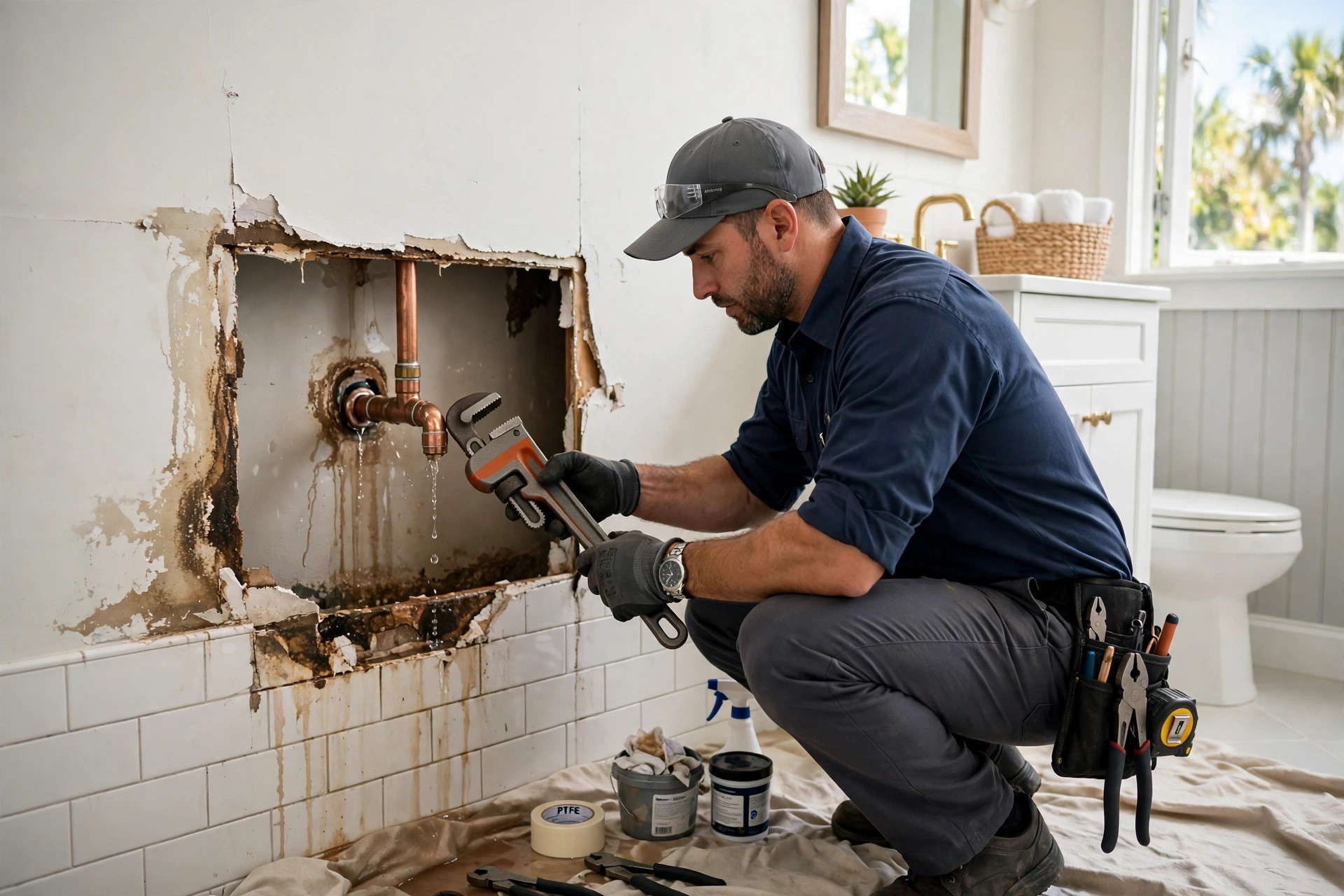
Plumber repairing a leaking copper water pipe inside an opened section of drywall in a Fort Myers, Florida home bathroom wall
DIRECT ANSWER

How Much Does It Cost to Repair a Water Leak Behind a Wall in Fort Myers, FL?

Repairing a water leak behind a wall in Fort Myers, FL typically costs $500–$1,500 all-in for a straightforward job: the pipe repair itself usually runs $275–$650, and repairing the drywall afterwards adds $300–$930. If the leak ran unnoticed for weeks and soaked insulation, framing, or flooring, the total can reach $1,350–$6,300 once drying and water damage restoration are included. Detection is a separate step — non-invasive electronic leak detection runs $400–$800 when the leak cannot be seen — and the most common mistake homeowners make is paying for the pipe fix without budgeting for the wall, the drying, and the paint that come after it.

Cost Table

Water Leak Behind a Wall Repair Cost in Fort Myers, FL

Part of the jobTypical Fort Myers price (2026)What it covers
Non-invasive leak detection (if leak is hidden)$400–$800Electronic listening, thermal imaging, and pressure testing to pinpoint the leak before cutting
Pipe repair — small section behind a wall$275–$650Cutting access, replacing the failed section of copper or PEX, pressure-testing the fix
Drywall removal and replacement$300–$930Cutting out wet drywall, replacing the section, taping, mudding, and sanding
Drying and dehumidification$200–$600+Fans and dehumidifiers run for 2–4 days to dry the wall cavity, insulation, and framing
Paint, texture, and trim$150–$400Matching texture and paint, replacing baseboards or trim damaged by water
Water damage restoration (if leak ran long)$1,350–$6,300Full drying, damaged-material removal, and restoration — national average around $3,800
Typical all-in total, straightforward job$500–$1,500Pipe repair + drywall + paint, with the leak caught early

These are planning ranges for residential work in the Fort Myers area, not binding quotes. Your exact price depends on how long the leak ran, which pipe failed, how much wall has to open, and what the water touched on its way down. Every reputable company quotes the full scope in writing before work starts — if a quote covers only the pipe and says nothing about the wall, the drying, or the paint, that is not the whole price.

Bill Parts

Why the Pipe Is Usually the Cheapest Part

Most homeowners expect the plumbing to be the expensive part. It rarely is. A small section of failed copper or PEX behind a wall typically costs $275–$650 to repair once the wall is open — the part itself is a few dollars of pipe and fittings, and the work is an hour or two for an experienced technician. What makes the job expensive is everything around the pipe.

First comes access. A plumber has to cut into the drywall to reach the leak, and the opening is usually bigger than the stain on the surface — water travels along studs and pipes, so the wet area inside the wall is almost always larger than what you can see. Then comes the wall itself: replacing a section of drywall, taping and mudding the seams, sanding, and matching the texture runs $300–$930. In one widely cited example, a $400 pipe repair behind a bathroom wall became a $2,500 project once drywall, drying, and flooring were added — the plumbing was only about 14% of the final bill.

Then comes drying. Drywall, insulation, and wood framing hold water long after the leak stops, and in Fort Myers' humidity they do not dry on their own. Fans and dehumidifiers usually run for 2 to 4 days, and skipping this step is how a repaired leak turns into a mold problem a month later. And if the leak ran for weeks before anyone noticed — soaked insulation, swollen baseboards, warped flooring — the job crosses into water damage restoration, which averages around $3,800 nationally and typically runs $1,350–$6,300.

Pro tip

Ask for one written quote that covers the whole job — detection, access, pipe repair, drying, drywall, and paint. A quote that only names the pipe price is not a quote for the repair; it is a quote for the first third of it.

Cost Drivers

What Makes the Price Go Up or Down

Five things move the number more than anything else:

  1. How long the leak ran. This is the single biggest driver. A leak caught in days is a pipe repair and a drywall patch. A leak that ran for weeks means wet insulation, damaged framing, and possibly mold — and the restoration bill can be several times the plumbing bill. The stain you see today is the leak's last symptom, not its first.
  2. Supply line vs. drain line. A pressurized supply line leak sprays water continuously and does damage fast, but it is usually found quickly. A slow drain line leak can drip for months behind a wall with almost no visible sign — and a major drain repair can run $800–$8,000+ if the line is badly damaged or hard to reach.
  3. Which wall and what's in it. A leak in a hollow interior wall is a simple cut-and-patch. A leak in an exterior wall with insulation, a tiled shower wall, or a wall packed with electrical and plumbing is slower and more expensive to open and close properly.
  4. Whether detection is needed. If the leak is visible once the wall is open, there is no detection charge. If the source is hidden — no stain, no sound, just a rising water bill — non-invasive electronic detection runs $400–$800, and it is worth every dollar: cutting blindly into walls to hunt for a leak costs more in drywall than the detection ever would.
  5. Mold and secondary damage. In Florida, mold can start growing in a wet wall cavity within 24 to 48 hours. If mold is found, remediation is a separate, regulated job — and it is the reason a "small" leak that sat for a month costs far more than the same leak fixed the week it started.
Warning

Do not just paint over a damp patch and hope. Paint seals moisture inside the wall, the drywall keeps rotting behind it, and the next sign is usually a soft spot, a smell, or a mold problem that costs far more than the original repair. If a wall is damp, the water source has to be found and fixed first — the cosmetic repair comes last.

Signs

How to Tell the Leak Has Been Running a While

A fresh leak and an old leak look different, and the difference is money. Call sooner if you notice any of these: paint or wallpaper bubbling or peeling, a wall that feels cool or soft to the touch, baseboards pulling away from the wall or swelling at the bottom, a musty smell that air freshener does not fix, or a water bill that crept up over two or three months. A stain that keeps growing after a rainstorm stops is a plumbing leak, not a roof leak — and a stain on a ceiling below a bathroom usually means the leak is in the wall or floor above it.

The meter test settles it in fifteen minutes: turn off every faucet, appliance, and irrigation zone, then watch the water meter. If the dial moves with everything off, water is leaving the system somewhere. That single check tells you whether you have a leak at all — and it is the evidence to have ready when you call.

Process

What Happens Step by Step

A proper wall leak repair follows the same sequence, and knowing it helps you judge any quote:

1. Confirm and locate. The technician runs the meter test and, if the leak is hidden, uses acoustic listening and thermal imaging to pinpoint it — usually within a foot or two — before any drywall is cut. Hidden water leak detection is the right service when you know water is escaping but cannot see where.

2. Open the wall. A clean access cut is made, usually larger than the stain, so the full wet area is visible. A good technician cuts along stud lines so the patch goes back cleanly.

3. Fix the pipe. The failed section is cut out and replaced — copper or PEX, with new fittings — and the line is pressure-tested before the wall is closed. This is the part pipe leak repair covers.

4. Dry everything. Fans and dehumidifiers run until the cavity, insulation, and framing test dry. This takes 2 to 4 days and cannot be rushed; closing a damp wall is how mold starts.

5. Rebuild the wall. Wet drywall is replaced, seams are taped and mudded, texture is matched, and the wall is painted. If the leak also reached a ceiling below, wall and ceiling leak repair covers both surfaces in one job.

6. Check the cause. A single pinhole in old copper is one thing. Repeated pinholes, green corrosion, or high water pressure mean the problem will come back in another wall — ask whether a pressure test or a partial repipe is the honest fix.

Insurance

Does Homeowners Insurance Cover a Leak Behind a Wall?

Often, yes — with an important distinction. Most Florida homeowners policies cover sudden and accidental water damage, including the cost to open the wall, dry the area, and repair the damage the water caused. What they usually do not cover is the pipe itself if it failed from age, corrosion, or long-term wear — and they do not cover damage from a leak that ran for months because it was ignored, which insurers treat as maintenance. The practical rule: document everything. Photograph the stain, the meter reading, and the opened wall; keep the detection report and the written quote; and call your insurer before the wall is closed, because an adjuster who cannot see the damage may not pay for it. If water is actively coming through the wall or ceiling right now, call for emergency water leak repair first and sort the claim after the water is stopped.

Fort Myers

Why Wall Leaks Are Different in Fort Myers

Fort Myers homes are built mostly slab-on-grade, with no basement or crawl space for a leak to show itself. A supply line that fails inside a wall has nowhere to drain — it soaks the drywall, the insulation, and the framing, and the first sign is often a stain on the wall or a ceiling below, not a puddle. The humidity makes the clock shorter, too: a wet wall cavity in Lee County can grow mold within 24 to 48 hours, which is why drying is not optional here the way it might be in a dry climate.

The other Fort Myers factor is age. Many homes in the area still run original copper supply lines, and pinhole leaks from corrosion are one of the most common wall-leak causes in the city. One pinhole is a repair; several pinholes in a year is a sign the lines are reaching the end of their life. Whether you live in Downtown Fort Myers, San Carlos Park, Iona, or South Fort Myers, the advice is the same: confirm the leak with the meter test, get a written quote that covers the pipe and the wall, insist on proper drying before the wall is closed, and do not let a small stain wait — in this climate, waiting is the most expensive part of the job. If you are not sure where the water is coming from, start with water leak detection and let the equipment decide where to cut.

FAQ

Water Leak Behind a Wall Repair Cost: Homeowners Ask

A straightforward job typically costs $500–$1,500 all-in: $275–$650 for the pipe repair and $300–$930 for the drywall repair, plus paint. If the leak ran for weeks and needs drying and restoration, the total can reach $1,350–$6,300. Detection, when needed, is a separate $400–$800.

Drywall repair after a leak typically costs $300–$930, depending on the size of the opening and whether texture and paint matching are included. Small patches can be less; a full section replacement with texture and paint is at the higher end. This is separate from the plumbing repair.

The pipe repair itself usually takes a few hours once the wall is open. Drying takes 2 to 4 days with fans and dehumidifiers, and the drywall and paint work follows once everything tests dry. A straightforward job is typically finished within a week; restoration work takes longer.

Often, yes, for sudden and accidental leaks — including opening the wall, drying, and repairing the water damage. Policies usually do not cover the failed pipe itself if it wore out from age, or damage from a leak that went unrepaired for months. Document the damage with photos and the detection report, and call your insurer before the wall is closed.

You can turn off the water and cut a small inspection opening to see the damage, but the repair itself — replacing a pressurized pipe section and pressure-testing it — is not a beginner job, and a bad joint behind a closed wall leaks silently for months. A professional repair with a written quote and a pressure test is the cheaper path in the long run.

Ask for a written quote that covers detection, access, the pipe repair, drying, drywall, and paint — not just the pipe. Ask how the price changes if mold or more damage is found once the wall is open, whether the detection fee is credited toward the repair, and whether you will get photos and a written report for your insurance claim.

Water Leaking Behind a Wall? Get It Found and Fixed Before the Bill Grows

Our 24/7 dispatch connects Fort Myers homeowners with local leak detection pros who find the leak before anyone cuts, digs, or demolishes — day or night, anywhere in Lee County.